Zinc & S1P Receptor modulators/antagonists: New Frontiers in COVID-19 Therapy
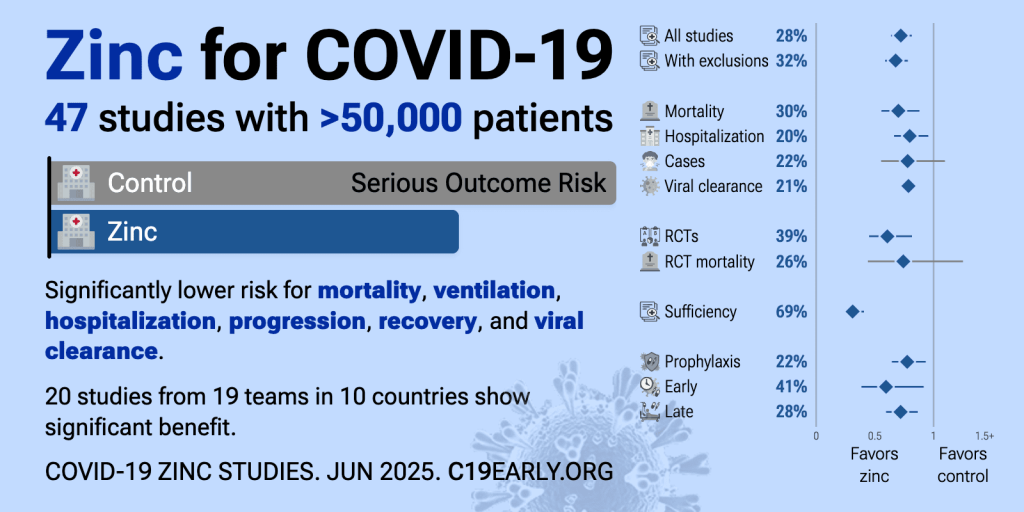
The European Food Safety Authority has found evidence for a causal relationship between the intake of zinc and optimal immune system function. Over-supplementation may be detrimental. Bioaccessibility of supplements varies widely. Zinc was adopted in 23 countries. Recent:Brandão Kafeshani Mohamed Hasan Anber.
Apr 16 Covid Analysis Zinc reduces COVID-19 risk: real-time meta analysis of 46 studies
Significantly lower risk is seen for mortality, ventilation, hospitalization, progression, recovery, and viral clearance. 19 studies…
Apr 11 Raspado et al., JMIR Formative R Oxidative Stress Markers and Prediction of Severity With a Machine Learning Appr…
Retrospective 28 hospitalized COVID-19 patients showing an association between oxidative stress biomarkers and disease…
Mar 25Perestiuk et al., Frontiers in Nutritio Association of zinc deficiency and clinical symptoms, inflammatory markers, severity
280% higher severe cases (p=1). Prospective study of 140 hospitalized children with COVID-19 in Ukraine showing that zinc…
Mar 25Gkioulekas et al., The Japanese J… Critical appraisal of multidrug therapy in the ambulatory management of patients
Critical appraisal of three case series totaling 119 COVID-19 patients with hypoxemia treated with ivermectin-based multid…
Mar 14Brandão et al., Frontiers in Nutritio Vaccination and food consumption: association with Post-Acute COVID-19 Syndr…
34% lower PASC (p=0.01). Analysis of 2,065 Brazilian adults participating in the CUME study showing that higher intake of …
Mar 4 Kafeshani et al., Journal of Health… Investigating the Relationship between Food Intake and Severity of COVID-19…
Cross-sectional study of 3,018 hospitalized (moderate and severe) and 717 outpatient (mild) COVID-19 patients showing…
Jan 16 Sanduzzi Zamparelli et al., Life, d… Immune-Boosting and Antiviral Effects of Antioxidants in COVID-19 Pneumonia: A …
Review of immune-boosting and antiviral effects of antioxidants in COVID-19 pneumonia. Authors provide an overview of the…
Jan 6 Raval et al., Cureus, doi:10.7759/c… Zinc Deficiency Associated With an Increase in Mortality in COVID-19 Patients: A Met…
Meta-analysis showing significantly higher COVID-19 mortality and symptomatology with zinc deficiency.
Nov 13 2024 Lee et al., Scientific Reports, doi:1… Elimination of olfactory sensory neurons by zinc sulfate inoculation prevents SARS-…
Mouse study showing that zinc sulfate protects K18-hACE2 transgenic mice from lethal SARS-CoV-2 infection by preventing…
| Nov 11 2024 Fazli et al., Journal of Medical Bac… Possible Link between Gut Microbiota, Diet, and COVID-19 Infection |
Review of the relationship between gut microbiota, diet, and COVID-19 infection. Authors analyze how SARS-CoV-2 infectio
Nov 1 2024 Avella et al., NCT05783180 A Randomized, Double-Blinded, Placebo-Controlled, Phase 2 Study to Evaluate the…
Estimated 40 patient zinc early treatment RCT with results expected soon (estimated completion over 5 months ago).
Oct 16 2024 Matsumoto et al., International Jo… Association Between Serum Zinc Concentration Levels And Severity Of Coronavirus…
72% lower severe cases (p=0.002). Retrospective 467 hospitalized COVID-19 patients in Japan showing significantly higher…
Oct 16 2024 Hung et al., Cureus, doi:10.7759/c… Zinc Deficiency and Post-acute Outcomes in Patients With COVID-19: A Six-Month
42% lower mortality (p=0.05) and 24% lower hospitalization (p<0.0001). TriNetX PSM retrospective 3,726 post-acute COVID-1…
Oct 5 2024 Anber et al., Reports of Biochemistry & Molecular Biology, 13:2 Assessment of Oxidative Stress Parameters in Iraqi Male Patients with Covid-19; A Case Control Study
Analysis of 50 symptomatic COVID-19 patients (25 ICU and 25 non-ICU) and 25 healthy controls, showing significantly lower vitamin C, zinc, and selenium levels in COVID-19 patients versus healthy controls, and in ICU patients versus non-IC..
Sep 24 2024 Grosman-Dziewiszek et al., Nutrients, doi:10.3390/nu16193225 Patterns of Dietary Supplement Use during the COVID-19 Pandemic in Poland: Focus on Vitamin D and Magnesium
Survey of 926 Polish pharmacy patients showing a high prevalence of dietary supplemention during the COVID-19 pandemic, with vitamin D and magnesium being the most commonly used. Supplement use was significantly higher among women, those ..
Sep 16 2024 Mu et al., Journal of Agriculture and Food Research, doi:10.1016/j.jafr.2024.101422 Anti-inflammatory and Nutritional Interventions Against SARS-CoV-2: A Comprehensive Review
Review of anti-inflammatory and nutritional interventions against SARS-CoV-2. Authors emphasize the importance of a healthy immune response in reducing the severity of COVID-19 , especially in high-risk groups like the elderly, drawing parallels between nutritional support and pharmaceutical modulation via S1P Receptor modulators/antagonists.
Sep 2 2024 Secerlı et al., Toxicology Research, doi:10.1093/toxres/tfae177 Effects of Immunotoxicity biomarkers, essential elements and vitamin D levels on the severity levels of COVID-19 disease in Turkey
Analysis of 52 COVID-19 patients and 20 healthy controls, showing lower vitamin D, zinc, and selenium levels associated with COVID-19 progression.
Aug 6 2024 Al-Fartusie et al., Indian Journal of Clinical Biochemistry, doi:10.1007/s12291-024-01254-4 Comparison of Serum Zn, Cu, Mg, Mn, Cr, and Fe Levels in Iraqi COVID-19 Patients and their Association with Infection Severity.
Retrospective 78 hospitalized COVID-19 patients and 40 healthy controls, showing significantly lower zinc levels in COVID-19 patients. There was no significant difference for moderate vs. severe patients.
Aug 1 2024 Hasan Anber et al., Reports of Biochemistry and Molecular Biology, doi:10.61186/rbmb.13.2.167 Assessment of Oxidative Stress Parameters in Iraqi Male Patients with COVID-19; A Case Control Study
Case-control study of 50 COVID-19 patients and 25 healthy controls, showing significantly lower zinc, selenium, and vitamins C levels in COVID-19 patients versus healthy controls, and in ICU patients versus non-ICU patients.
Jul 24 2024 Ferreira et al., Bioscience Reports, doi:10.1042/BSR20240617 Boosting Immunity: Synergistic Antiviral Effects of Luteolin, Vitamin C, Magnesium, and Zinc Against SARS-CoV-2 3CLpro…
In Vitro and In Silico study showing synergistic antiviral effects of luteolin, vitamin C, magnesium, and zinc against SARS-CoV-2 3CLpro. Authors found that luteolin inhibited SARS-CoV-2 3CLpro with an IC50 of 78 μM, which decreased 10-fo..
Jul 5 2024 AlKhuzaie et al., Problems of Virology, doi:10.36233/0507-4088-236 Electrolytes, Zinc and Vitamin D3 in COVID-19 Patients with Cardiovascular Complications
Retrospective 142 COVID-19 patients and 50 controls showing significantly lower levels of zinc, vitamin D, calcium, potassium, and sodium in COVID-19 patients compared to controls. Lower levels of zinc, vitamin D, calcium, and sodium were..
May 10 2024 Hazan et al., Cureus, doi:10.7759/cureus.60038 Bifidobacterium Against COVID-19: A Mother and Her Newborn’s Gut Microbiome
Case report of a mother and her newborn infected with COVID-19 within two weeks of the baby’s birth. Authors propose that the disease course was altered by maternal supplementation of vitamins C and D and zinc starting after exposure on d..
Apr 30 2024 Milan et al., Acta Medica Philippina, doi:10.47895/amp.v58i7.8392 Factors Associated with Adverse Outcomes among SARS-CoV-2 Positive Children in a Tertiary Government COVID-19 Referral Hospital in the Philippines
56% lower mortality (p=0.09), 13% lower ventilation (p=0.67), and 10% lower ICU admission (p=0.84). Retrospective 180 hospitalized pediatric COVID-19 patients in the Philippines showing lower mortality with vitamin D and zinc, and higher mortality with remdesivir, all without statistical significance. Remdesivir was given to few patient..
Apr 19 2024 Jin et al., Frontiers in Nutrition, doi:10.3389/fnut.2024.1385591 The nutritional roles of zinc for immune system and COVID-19 patients.
Review of zinc for the immune system and COVID-19. Zinc is an essential trace element that plays a critical role in the immune system, immune cell function, and cell signaling. Authors discuss the importance of zinc in human health, zinc ..
Apr 16 2024 Agamah et al., ScienceOpen, doi:10.58647… Network-based multi-omics-disease-drug associations reveal drug repurposing candidates for COVID-19 disease phases
In Silico study identifying potential drugs beneficial for COVID-19 by integrating transcriptomics, proteomics, metabolomics, lipidomics, and drug data. Authors explore interactions between drugs, molecular features, and disease severity…
Apr 5 2024 Lockwood, T., BioMetals, doi:10.1007/s10534-024-00590-5 Coordination chemistry suggests that independently observed benefits of metformin and Zn2+ against COVID-19 are not independent
In Silico analysis suggesting potential benefits of metformin and zinc for COVID-19. Author proposes that metformin can form a complex with zinc ions, increasing zinc bioavailability, and that the metformin-zinc complex may slow viral mul..
Apr 5 2024 Noce et al., Pharmaceuticals, doi:10.3390/ph17040463 Potential Anti-Inflammatory and Anti-Fatigue Effects of an Oral Food Supplement in Long COVID Patients
RCT of 33 long COVID outpatients showing anti-inflammatory and anti-fatigue effects with treatment based on Echinacea angustifolia, rosehip, propolis, royal jelly, and zinc. The treatment significantly reduced inflammatory biomarkers like..
Mar 24 2024 Mosadegh et al., AMB Express, doi:10.1186/s13568-024-01690-8 NBS superfood: a promising adjunctive therapy in critically ill ICU patients with omicron variant of COVID-19
RCT 400 critically ill ICU patients with omicron-related ARDS showing significantly reduced mortality and inflammatory markers with a nutritional supplement containing vitamins A, B1–B3, B5, B6, B9, C, D, K, and zinc, potassium, manganese..
Mar 15 2024 Kim et al., Nutrients, doi:10.3390/nu16060850 Increasing Natural Killer Cell Activity of Mineral Nanomaterial ALP1018 in Healthy Adults:… Randomized, Double-Blind, Placebo Comparative Clinical Trial
RCT 80 healthy adults in Korea showing increased natural killer cell activity with ALP1018, a nanomineral supplement containing iron and zinc. The study found a statistically significant increase in NK cell activity at an E:T ratio of 50:..
References
1. Galmés et al., Suboptimal Consumption of Relevant Immune System Micronutrients Is Associated with a Worse Impact of COVID-19 in Spanish Populations, Nutrients, mdpi.com, doi.org.
2. Galmés (B) et al., Current State of Evidence: Influence of Nutritional and Nutrigenetic Factors on Immunity in the COVID-19 Pandemic Framework, Nutrients, mdpi.com, doi.org.
3. karger.com, www.karger.com/Article/FullText/528899.
4. Ośko et al., Comparison of the Potential Relative Bioaccessibility of Zinc Supplements—In Vitro Studies, Nutrients, mdpi.com, doi.org.
Please send us corrections, updates, or comments. c19early involves the extraction of 100,000+ datapoints from thousands of papers. Community updates help ensure high accuracy. Treatments and other interventions are complementary. All practical, effective, and safe means should be used based on risk/benefit analysis. No treatment or intervention is 100% available and effective for all current and future variants. We do not provide medical advice. Before taking any medication, consult a qualified physician who can provide personalized advice and details of risks and benefits based on your medical history and situation. IMA and WCH provide treatment protocols.